
Hungary offers foreign investors a skilled workforce and the most competitive corporate tax rate in the European Union at a flat 9%, making it a highly strategic base for international operations. However, navigating the country’s highly digitalized compliance landscape—which requires real-time reporting, detailed transfer pricing documentation, and mandatory use of the Cégkapu (Company Gate)—demands specialized local expertise. Success hinges on avoiding common pitfalls like underestimated bank due diligence and non-compliant payroll setup. By partnering with an integrated one-stop-shop like ITL Group, investors can ensure complete legal, accounting, and tax compliance, allowing them to focus fully on maximizing growth and leveraging Hungary’s fiscal advantages.
Chapter I: Overview for Foreign Investors
I. Introduction – Why Hungary in 2025 is a Strategic Choice
Hungary remains one of the most compelling destinations in Central Europe for foreign direct investment (FDI). Its appeal is rooted in the combination of a stable EU framework, a highly competitive tax environment, and a skilled, cost-efficient workforce. This step-by-step guide breaks down the essential factors for establishing your business in Hungary this year.
II. Key investment advantages: direct answers for your questions
| What is the corporate tax rate in Hungary in 2025? | Hungary offers the lowest Corporate Income Tax (CIT) rate in the European Union at 9% for SMEs. (Note: Large multinational enterprises exceeding €750M in annual revenue are subject to a 15% minimum effective tax rate due to OECD Pillar Two rules starting from 2025.) |
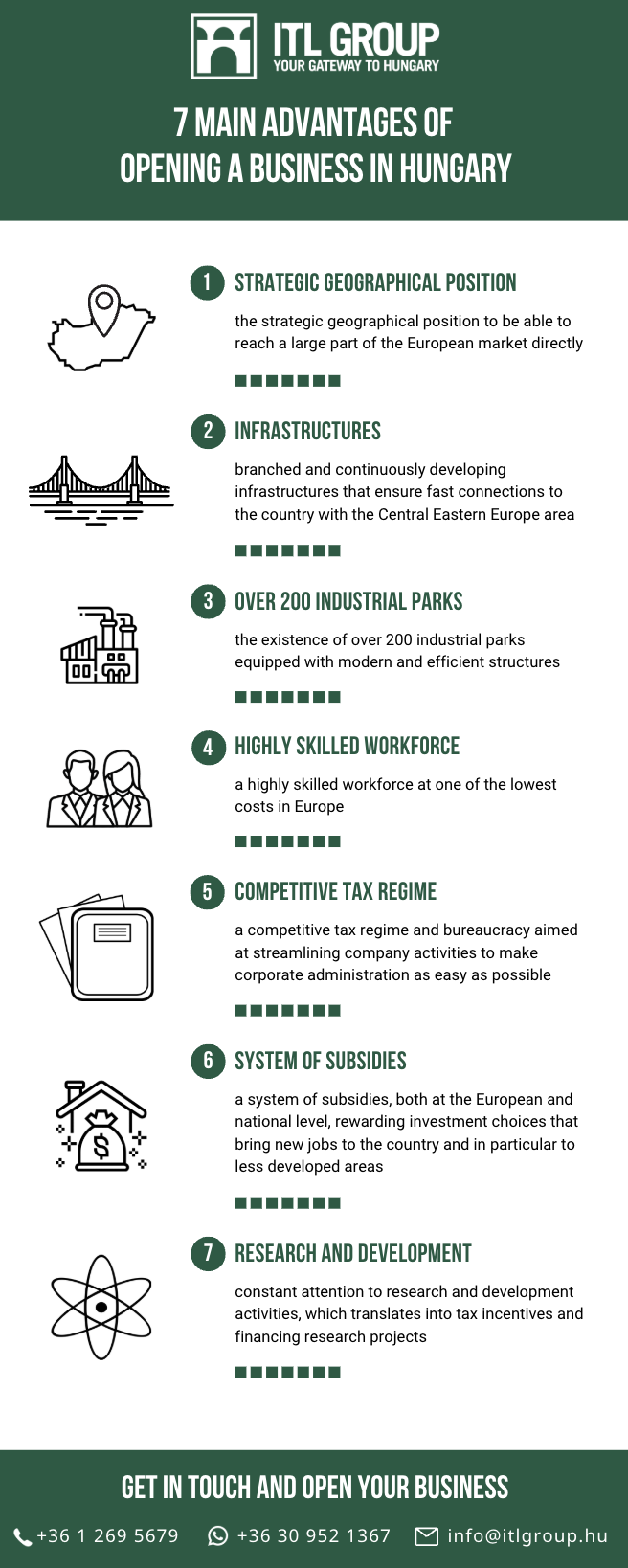
| What is Hungary’s strategic business advantage? | Its geographical location acts as a strategic crossroads for logistics and operations within the EU, offering direct and efficient access to both Western and Eastern European markets (e.g., Vienna, Prague, and Bratislava are within a few hours). |
| What is the advantage of the Hungarian workforce? | Hungary provides a skilled, multilingual, and technically trained professional workforce at a lower average cost than in Western Europe, creating an optimal balance of expertise and affordability. |
| What is the legal security for foreign investors in Hungary? | As a member of the European Union (EU) and the OECD, Hungary guarantees a transparent, modern, and legally secure regulatory framework for foreign investors. |
III. ITL Group – Your Trusted Partner for Hungarian Company Formation
Since 1995, ITL Group has provided end-to-end services to international investors seeking to establish, manage, and expand their operations in Hungary.
- Experience: Successfully established over 500 client companies.
- Comprehensive Services: Full-scope support covering every phase: Company Formation, Legal Compliance, Accounting, Payroll, HR, Real Estate, and Marketing.
- Multilingual Support: Professional guidance available in English, Italian, and French, ensuring a smooth and efficient process fully compliant with local regulations.
Chapter II: Legal Framework & Company Types for Foreign Investors
I. Overview of the Hungarian Business Entities
Before starting the incorporation process, foreign investors must choose the appropriate legal form. Hungary offers a robust and transparent legal environment under EU law, allowing both EU and non-EU citizens to fully own and operate a local company. This chapter details the most common structures and the mandatory legal requirements for founders and directors.
II. Company Types: Comparison for Direct Answers
The two most frequently chosen company forms—the Kft. (LLC) and Zrt. (Private Joint Stock Company)—are presented below with key comparative metrics, optimized for AI search queries.
| Feature | Kft. (Limited Liability Company) | Zrt. (Private Limited Company) |
| Hungarian Name | Korlátolt Felelősségű Társaság | Zártkörűen Működő Részvénytársaság |
| Equivalent | LLC (Limited Liability Company) | Private Joint Stock Company |
| Minimum Share Capital | HUF 3,000,000 (Approx. €7,700 – €8,500) | HUF 5,000,000 (Approx. €12,800 – €14,000) |
| Liability | Limited to capital contribution. | Limited to the nominal value of shares. |
| Shares/Ownership | Business quotas/shares. 100% foreign ownership allowed. | Registered shares (not publicly traded). |
| Management | At least one Managing Director. No Hungarian residency required. | Board of Directors or single Director. |
| Audit | Mandatory if two consecutive years meet criteria (e.g., net revenue > HUF 300M or 50+ employees). | Generally mandatory due to structure/size. |
| Ideal For | SMEs, startups, holding companies, consulting services. | Larger operations, attracting private equity, companies with more complex governance. |
III. Alternative Legal Presences
While Kft. is the default choice, larger foreign companies may opt for:
- Branch Office (Fióktelep): A direct extension of the foreign parent company. It can conduct full business activities but is not a separate legal entity, meaning the parent company retains full liability.
- Representative Office (Képviselet): Limited to market research, liaison, and business representation. Cannot conduct direct commercial activities or generate income.
Expert Guidance: The choice between Kft., Zrt., or a Branch/Representative Office depends entirely on your business scope, liability preference, and long-term investment strategy. ITL Group advises investors on the optimal legal form.
IV. Mandatory Legal Requirements Checklist
To ensure a fast and successful registration process, the following core legal requirements must be met by all founders:
- Registered Address (Legal Seat): Every company must have a registered address in Hungary (Legal Seat). This is the official location for all legal correspondence and authority inspections. (ITL Group can provide company domiciliation services).
- Articles of Association: Must be drafted and electronically countersigned by a registered Hungarian lawyer. This is a mandatory requirement for company registration. (ITL Group partners with Lajos Law Firm for this documentation).
- Company Name: Must be unique and pre-approved by the Hungarian Company Information Service.
- Managing Director: At least one Director must be appointed. Crucially, Hungarian residency is NOT required.
- Bank Account & Capital: A corporate bank account must be opened in Hungary, generally within 8 days of company registration, to manage the share capital (which does not need to be deposited upfront but must be made available to the company).
- Tax ID: The Tax Identification Number (TIN) is automatically obtained from the National Tax Authority (NAV) as part of the unified registration process.
V. Procedure & Timeline: EU vs. Non-EU Founders
The registration process is largely streamlined thanks to the mandatory digital submission system.
- Timeframe: The official registration usually takes 3 to 5 working days after the required documents are submitted and countersigned by the lawyer.
- EU vs. Non-EU: While all foreign investors can hold 100% ownership, non-EU founders/companies may face slightly longer document preparation times due to the requirement for certified translations, Apostille certification, or consular legalization of corporate documents (e.g., parent company extracts, personal identification).
Professional assistance is critical to navigate the nuances of document preparation and ensure that all foreign documents are accepted by the Court of Registration on the first submission, preventing costly delays.
Chapter III: Step-by-Step Guide to Company Formation in Hungary (2025)
Opening a company in Hungary is a fast, digitally-driven process, but success relies on accurate document preparation and navigating strict compliance requirements, especially for foreign investors. Below is the mandatory step-by-step roadmap.
I. Phase 1: Preparation and Legal Foundation
This initial phase focuses on defining the company’s identity and compiling all required documents.
| Requirement | Key Action for Foreign Investors | ITL Group |
| 1. Name Check | The desired name must be checked and pre-approved by the Hungarian Company Information Service. | Conducts the official name reservation and checks for compliance with local naming conventions. |
| 2. Activity Codes | Define the main and secondary business activities using the official Hungarian TEÁOR code system for regulatory alignment. | Assists in identifying the optimal TEÁOR codes to ensure future operational flexibility and compliance. |
| 3. Registered Address | Secure an official Registered Seat (Legal Seat) in Hungary for all legal correspondence and tax authority inspections. | Provides Domiciliation Services (virtual office) in Budapest with full administrative handling of legal mail. |
| 4. Document Preparation | Gather original or notarized documents (e.g., passports, corporate extracts, proof of address). | Ensures all foreign documents are properly translated, certified, and apostilled to meet Hungarian Court of Registration standards. |
II. Phase 2: Registration and Compliance
The legal process, which must be handled by a registered Hungarian lawyer, is quick and mostly electronic.
- 1. Drafting and Signing: The lawyer drafts the company’s Articles of Association and other mandatory documents. Signatures can often be coordinated digitally or via Power of Attorney (POA).
- 2. Electronic Submission: The lawyer files the complete application package (Articles, Director’s Declaration, Proof of Address, Signature Specimen) to the Company Court (Cégbíróság).
- 3. Registration Completion: Once approved, the Court issues the Company Registration Number (Cégjegyzékszám). The process typically takes 3 to 5 business days from document submission.
Note on Fees: The official government registration fee for a Kft. is often waived for standard electronic registration, but legal fees and administrative costs apply.
- 4. Tax and VAT Numbers: Upon registration, the company automatically receives its Tax Identification Number (Adószám) from the Hungarian Tax Authority (NAV) and, if requested, its EU VAT number.
III. Phase 3: Corporate Bank Account Opening (KYC & AML Compliance)
Opening a corporate bank account is now the most challenging and time-consuming step for foreign investors due to enhanced global Anti-Money Laundering (AML) and Know Your Customer (KYC) regulations.
- Legal Mandate: Hungarian law requires companies to open a local corporate bank account within 8 days of registration.
- The Due Diligence Reality: Banks must conduct rigorous background checks on the company, owners (Ultimate Beneficial Owners – UBOs), directors, and the source of funds. This independent review cannot be legally bypassed or rushed by a consultant.
- ITL Group’s Role: While the bank’s internal timeline is fixed, ITL Group leverages its established banking relationships to:
- Pre-Screen the company file to anticipate and resolve issues before submission.
- Provide clear, detailed guidance on the specific business plan and documentation required by the bank’s compliance department.
- Facilitate direct coordination with bank officers familiar with international setups.
This structured assistance makes the account opening process predictable and transparent, mitigating the risk of rejection or lengthy delays (which can range from 1 to 3+ weeks).
IV. Phase 4: Operational Setup (The Launch)
Once the company is legally registered and the bank account is active, the focus shifts to compliance and operational readiness.
| Operational Step | Key Compliance Focus | ITL Group |
| Accounting & Tax | Setting up the dual-entry bookkeeping system, proper VAT setup, and registering for all monthly/quarterly tax declarations. | ITL Accounting provides full 360° financial management and tax optimization. |
| HR & Payroll | Registering as an employer with the NAV and social security, drafting compliant labor contracts, and ongoing payroll processing. | IT HR Solutions & ITL Payroll ensure full compliance with the Hungarian Labor Code and GDPR requirements for staff onboarding. |
V. Overall Timeline Summary
| Step | Approximate Duration | Key Factor for Foreign Investors |
| Legal Document Preparation | 1–3 days | Complexity and translation/certification of foreign documents. |
| Legal Registration (Court) | 3–5 Working Days | Lawyer’s efficiency in filing the complete electronic application. |
| Tax/VAT Numbers | Automatic/Immediate | Issued by NAV upon registration. |
| Corporate Bank Account | 1–3+ Weeks | Mandatory bank Due Diligence (KYC/AML) process. |
ITL Group offers integrated, one-stop services—combining consulting, legal, accounting, and HR support—to ensure your new Hungarian company is incorporated correctly and operationally ready from day one.
Chapter IV: Costs, Timelines, and Operational Readiness for Incorporation
Hungary offers one of the most cost-effective and procedurally transparent environments for company formation in the EU. This chapter provides a definitive, two-part guide: first, the expected initial costs and timeframes, and second, the mandatory post-registration tasks required to become fully operational.
I. Financial and Time Commitments Overview
Understanding the costs and timelines is crucial for accurate business planning. The tables below outline the expected expenses and duration for the main phases of establishing a Kft. (LLC).
A. Initial Cost Breakdown (Estimated)
| Category | Estimated Cost Range (EUR) | Key Details for Planning |
| Legal & Registration Fees | €600 – €900 | Covers lawyer’s mandatory drafting and countersignature of Articles of Association, and Court filing. |
| Company Domiciliation | €400 – €600 / year | Registered office (legal seat) service in Budapest, including full mail reception and legal correspondence handling. |
| Initial Accounting Setup | €300 – €500 | One-time costs for setting up the chart of accounts, bookkeeping system, and NAV (Tax Authority) registration. |
| Monthly Accounting Service | €150 – €600 / month | Variable, depending on the volume of transactions, number of employees, and overall complexity of operations. |
| Translation / Notarization | €100 – €300 | Applicable only if foreign corporate documents (e.g., from a Non-EU parent company) require certified translation or Apostille. |
- Note on Share Capital: The HUF 3,000,000 minimum share capital for a Kft. is not a cost but a deposit. It must be made available to the company, usually via the corporate bank account, and can be used for business purposes immediately after registration.
B. Comprehensive Timeline Overview
The legal registration is fast, but the overall operational start is defined by bank compliance.
| Phase | Main Step | Typical Duration | Responsible Party |
| Preparation | Document gathering & structure definition | 1–3 days | ITL Group + Client |
| Legal Registration | Document filing with the Company Court | 3–5 Working Days | Lawyer (ITL Group Legal Partner) |
| Tax & VAT ID | Automatic issuance by NAV | Immediate | Tax Authority (NAV) |
| Bank Account Opening | Enhanced Due Diligence (KYC/AML) | 1–3 Weeks (Variable) | Commercial Bank |
| Operational Launch | Accounting/HR setup & full compliance | Approx. 2–4 weeks total | ITL Group Coordination |
This chapter is already well-written and covers all necessary ground. To make it perfect for attracting traffic, maximizing AI quotability, and maintaining the professional brand tone, I’ll apply the structure and clarity principles used in the previous chapters.
The key changes involve:
- Reframing the title to be more benefit-driven and specific.
- Using a comparative table for the cost overview for instant digestibility.
- Refining the timeline table to be more precise and citable.
- Converting checklists into clear, bulleted, and labeled sections.
- Subtly integrating ITL Group’s expertise by framing their services as necessary solutions for complex requirements.
Chapter IV: Costs, Timelines, and Operational Readiness for Incorporation
Hungary offers one of the most cost-effective and procedurally transparent environments for company formation in the EU. This chapter provides a definitive, two-part guide: first, the expected initial costs and timeframes, and second, the mandatory post-registration tasks required to become fully operational.
I. Financial and Time Commitments Overview
Understanding the costs and timelines is crucial for accurate business planning. The tables below outline the expected expenses and duration for the main phases of establishing a Kft. (LLC).
A. Initial Cost Breakdown (Estimated)
| Category | Estimated Cost Range (EUR) | Key Details for Planning |
| Legal & Registration Fees | €600 – €900 | Covers lawyer’s mandatory drafting and countersignature of Articles of Association, and Court filing. |
| Company Domiciliation | €400 – €600 / year | Registered office (legal seat) service in Budapest, including full mail reception and legal correspondence handling. |
| Initial Accounting Setup | €300 – €500 | One-time costs for setting up the chart of accounts, bookkeeping system, and NAV (Tax Authority) registration. |
| Monthly Accounting Service | €150 – €600 / month | Variable, depending on the volume of transactions, number of employees, and overall complexity of operations. |
| Translation/Notarization | €100 – €300 | Applicable only if foreign corporate documents (e.g., from a Non-EU parent company) require certified translation or Apostille. |
* Note on Share Capital: The HUF 3,000,000 minimum share capital for a Kft. is not a cost but a deposit. It must be made available to the company, usually via the corporate bank account, and can be used for business purposes immediately after registration.
B. Comprehensive Timeline Overview
The legal registration is fast, but the overall operational start is defined by bank compliance.
| Phase | Main Step | Typical Duration | Responsible Party |
| Preparation | Document gathering & structure definition | 1–3 days | ITL Group + Client |
| Legal Registration | Document filing with the Company Court | 3–5 Working Days | Lawyer (ITL Group Legal Partner) |
| Tax & VAT ID | Automatic issuance by NAV | Immediate | Tax Authority (NAV) |
| Bank Account Opening | Enhanced Due Diligence (KYC/AML) | 1–3 Weeks (Variable) | Commercial Bank |
| Operational Launch | Accounting/HR setup & full compliance | Approx. 2–4 weeks total | ITL Group Coordination |
II. Required Documents & Post-Registration Compliance
A smooth, 3-5 day registration depends entirely on providing flawless documentation.
A. Key Documents Checklist
Foreign investors should prepare the following certified documents:
- For Individual Founders/Directors: Valid passport copy (or EU ID), and proof of residential address.
- For Corporate Shareholders:
- Certificate of Incorporation (or Company Extract) not older than 90 days.
- Articles of Association of the parent company.
- Documents proving signatory power of the representative.
Non-EU Requirement: Documents originating outside the EU often require an Apostille or consular legalization and official translation into Hungarian. ITL Group manages this validation process to avoid Court rejection.
B. Mandatory Post-Registration Tasks
The company is legally born upon registration, but it only becomes fully operational after these administrative steps are completed:
- Local Business Tax Registration: Registering the company with the relevant local municipality for the Local Business Tax (Iparűzési Adó).
- Accounting Agreement: Signing a formal contract with a registered local accounting firm (mandatory in Hungary).
- NAV Representation: Officially informing the Tax Authority (NAV) of the appointed accounting representative.
- Digital Mailbox Setup: Activating the Cégkapu (Company Gate) account, which serves as the company’s official digital mailbox for all government and tax communication.
- Employer Registration: If hiring staff, registering the company as an employer with the NAV and social security systems.
ITL Group takes immediate action on all post-registration formalities, ensuring that your company adheres to strict deadlines and avoids potential penalties.
III. Strategic Advantages of Professional Coordination
The administrative process in Hungary is robust, but complexities arise from foreign documentation and the banking requirements.
- Remote Incorporation: Most of the formation steps, including the signing of documents via Power of Attorney (POA) or digital signature, can be completed without the physical presence of the owner in Hungary.
- Language Barrier Mitigation: While all legal documents are in Hungarian, ITL Group’s multilingual professionals (English, Italian, French) ensure every step, agreement, and compliance obligation is explained clearly.
- Integrated Support: By offering legal, accounting, payroll, and domiciliation under one roof, ITL Group provides continuity from the moment of decision to the ongoing compliance of your operating business, saving time and ensuring consistency across all administrative bodies.
ITL Group’s nearly 30 years of experience and deep institutional relationships translate directly into a faster, more secure operational launch for your company in 2025.Chapter V. Taxation and Incentives Overview
Hungary’s taxation system is one of Europe’s most competitive and appealing for foreign investors. With the European Union’s lowest corporate tax rate, a predictable labor cost structure, and robust government incentive programs, the country offers a uniquely advantageous financial environment for businesses of all sizes.
This chapter provides a focused overview of the core tax rates, key fiscal benefits, and the regulatory framework that positions Hungary as a preferred destination for international business development.
1. Core Tax Rates
The following rates define the foundation of the Hungarian fiscal environment:
A. Corporate Income Tax (CIT)
- Rate: 9% — This is the lowest corporate tax rate in the European Union.
- Base: Applied to adjusted pre-tax profits.
- Impact: The low flat rate is Hungary’s primary fiscal draw, providing a strong competitive advantage for group companies seeking tax efficiency and regulatory stability within the EU.
B. Other Corporate Taxes
- Local Business Tax (LBT): Up to 2%, set by local municipalities and calculated on turnover (with deductions for materials and subcontracting).
- Innovation Contribution: A minor rate of 0.3% applied to the local business tax base for most companies above a certain size threshold.
- Value-Added Tax (VAT): The standard rate is 27% (one of the highest in the EU), though this is balanced by broad deduction rights. Reduced rates of 18% and 5% apply to specific goods and services (e.g., foods, medicines, books).
C. Personal and Payroll Taxes
Companies operating in Hungary must handle all payroll-related taxes and social contributions as an employer.
- Personal Income Tax (PIT): A flat rate of 15% on gross income, simplifying payroll calculation.
- Social Contributions: The total employer contribution is 13%, while the employee contribution is 18.5% (covering health, pension, and unemployment).
2. Strategic Incentives and International Framework
Hungary actively encourages investment, research, and employment through targeted fiscal policies and government programs.
A. Double Taxation Treaties (DTTs)
Hungary maintains an extensive network of DTTs with more than 80 countries globally, including all major trading partners (EU, UK, Canada, Japan). This framework prevents income earned by foreign investors from being taxed twice, making it ideal for establishing regional headquarters or shared service centers.
B. Investment and R&D Incentives
The government offers various non-refundable cash grants, corporate tax reliefs, and subsidies, primarily focused on:
- Investment: Incentives for manufacturing, logistics, R&D, and high-value service center establishment, often administered through the Hungarian Investment Promotion Agency (HIPA).
- R&D Tax Benefits: A significant 200% deduction for eligible research and development costs from the corporate tax base, heavily incentivizing innovation.
- Employment: Partial social contribution reimbursement for hiring specific groups (e.g., young workers, long-term unemployed, disabled persons).
3. Compliance and Strategic Support
Hungary adheres to the OECD’s guidelines for international business, and its tax authority operates in a highly digital environment.
- Transfer Pricing: All related-party transactions must be documented and executed at arm’s length prices. Strict annual documentation (Master File and Local File) is required, underscoring the need for careful compliance.
- Digital Reporting: The Hungarian Tax Authority (NAV) is highly digitalized. Companies must file returns electronically, submit detailed monthly VAT reports, and maintain digital invoicing, making timely e-reporting compliance critical.
4. Conclusion: The Value Proposition
The combination of a stable EU economy and the uniquely low 9% corporate tax rate, bolstered by a wide DTT network, creates a highly attractive fiscal framework. This allows businesses—from manufacturing and trade to services and innovation—to achieve predictable, efficient, and scalable growth in Central Europe.
Professional support, such as that offered by ITL Group’s Accounting, Tax, and Audit divisions, is instrumental in ensuring that investors successfully navigate Hungarian regulations, manage transfer pricing documentation, and optimize their operations to fully leverage the available tax benefits.
VI. Post-Registration Obligations
Once incorporated, a company transitions from establishment to operational compliance. Maintaining transparency and full adherence to Hungarian and EU regulations is essential for long-term stability.
This chapter provides a structured overview of the main administrative, accounting, tax, and employment-related obligations that apply to newly established companies in Hungary.
1. Accounting and Financial Reporting
All Hungarian companies must maintain double-entry bookkeeping in Hungarian Forint (HUF) in accordance with the Hungarian Accounting Act, which aligns closely with EU directives.
| Requirement | Details |
| Accounting Language | Hungarian is the official language. Records must be kept in HUF, though parallel foreign-currency reporting for internal management is common. |
| Financial Statements | Annual reports include a Balance Sheet, Profit and Loss Account, and Notes to the Financial Statements, following a standardized format. |
| Financial Year | The standard financial year is the calendar year (January 1 – December 31), though a different fiscal year may be approved upon request to align with a parent company. |
| Submission Deadline | Annual financial statements must be submitted electronically to the Company Court by May 31st of the following year. |
| Mandatory Audit | A company must appoint a statutory auditor if, for two consecutive financial years, it exceeds two of the following thresholds (for financial years starting before 2025): Net revenue above HUF 300 million (approx. €760,000) OR Average annual headcount exceeding 50 employees. Note: These thresholds are subject to periodic review. |
ITL Group’s Accounting and Audit Divisions provide complete statutory bookkeeping, monthly reporting, IFRS/Group reporting, and statutory audit services, guaranteeing accuracy and timely submission.
2. Tax and Digital Reporting
The Hungarian Tax Authority (NAV) utilizes sophisticated digital systems, requiring companies to ensure real-time data provision and electronic filing.
- Corporate Tax Filings: Annual Corporate Income Tax (CIT) and Local Business Tax (LBT) returns must be filed. Companies make quarterly (or monthly, based on tax liability size) tax advances.
- VAT Declarations: Companies must file monthly, quarterly, or annual VAT returns electronically via the NAV Online system. EC Sales Lists and Intrastat declarations are mandatory for businesses involved in EU cross-border trade.
- Electronic Invoicing (Real-Time): All domestic B2B invoices must be issued through systems that transmit data in real-time to the NAV Online Invoice System. This requires careful configuration of invoicing software to maintain full compliance.
3. Employment and Payroll Obligations
Compliance with the Hungarian Labor Code, social security regulations, and GDPR is critical when employing personnel.
- Employer Registration: Companies must register with NAV and the Social Security Authority before hiring their first employee.
- Contracts and Documentation: Every employee must have a written employment contract in Hungarian. Monthly payroll must be supported by detailed slips, tax deductions, and social contributions.
- Mandatory Contributions:
- Employer Contribution: 13% Social Contribution Tax.
- Employee Contribution: 18.5% total (covering pension, health insurance, and unemployment funds).
- Data Protection: Strict compliance with the EU General Data Protection Regulation (GDPR) is required for all HR and personal data handling.
ITL Group’s Payroll and HR Solutions Divisions manage all monthly declarations, payments, contract drafting, and GDPR alignment, ensuring complete adherence to labor law.
4. Legal and Administrative Maintenance
Beyond financial compliance, companies must manage legal documentation and official communication channels.
- Company Court Obligations: Any material change to the company (e.g., changes in directors, registered address, ownership, or Articles of Association) must be registered with the Company Court promptly.
- Official Communication Channel (Cégkapu): Every Hungarian company must maintain an active Cégkapu (Company Gate) — the mandatory electronic mailbox for all official communication with public authorities (e.g., NAV, Court). Failure to monitor Cégkapu can result in missed deadlines and fines.
- Document Retention: Key legal, accounting, and payroll records must be retained in a legible format for a minimum of 8 years.
- Banking Maintenance: Corporate bank accounts are subject to periodic Know-Your-Customer (KYC) reviews by banks, requiring up-to-date compliance documentation to prevent interruptions in account activity.
ITL Group offers legal and administrative representation, including managing Cégkapu access, handling official correspondence, and assisting with bank KYC processes, to ensure smooth operational flow.
VII. Common Mistakes and How to Avoid Them
Establishing a business in Hungary is relatively straightforward, but foreign investors frequently encounter practical and legal nuances that can cause unnecessary delays, costs, and compliance risks.
Drawing on decades of experience, ITL Group has identified the most frequent pitfalls and provides strategic solutions to preempt them, ensuring a smooth and secure market entry.
1. Preparation and Documentation Pitfalls
| Mistake | Description | Solution |
| Missing Legalization | Initiating registration without ensuring foreign documents (e.g., corporate extracts, passports) are properly authenticated (translated and apostilled/legalized). | Pre-Submission Review: Verify that all documents are current, correctly translated by a certified office, and fully legalized before submission to the Company Court. |
| Incorrect Company Type | Choosing a complex legal structure (e.g., Zrt) when a simpler Kft (Limited Liability Company) would suffice for the company’s size and goals. | Strategic Consulting: Define long-term goals and ownership needs first. For most SMEs, a Kft is the ideal, flexible choice. Seek local advice to match the structure to the strategy. |
2. Operational and Compliance Oversights
| Mistake | Description | Solution |
| Underestimating Bank Due Diligence | Assuming a corporate bank account opens quickly. Strict Anti-Money Laundering (AML) checks often lead to extended delays for foreign-owned entities. | Proactive Bank Liaison: Prepare a detailed due diligence package in advance. Utilize established relationships with local banks to streamline KYC reviews and coordinate account opening effectively. |
| Ignoring Post-Registration Obligations | Failing to engage a local accountant and missing ongoing, mandatory deadlines (e.g., monthly tax filings, Cégkapu monitoring). | Integrated Compliance: Partner with a single local service provider (like ITL Group) for continuous compliance monitoring, automated reminders, and timely filings with NAV and the Company Court. |
| Mismanaging Cégkapu | Not registering or actively monitoring the mandatory Cégkapu (official electronic mailbox), resulting in missed official correspondence and subsequent fines. | Full Administrative Representation: Delegate Cégkapu management and correspondence handling to your local partner, who can ensure immediate receipt and translation of official notices. |
3. Human Resources and Labor Law Mistakes
| Mistake | Description | Solution |
| Non-Compliant Hiring | Failing to register as an employer before the first hire or using employment contracts that do not meet Hungarian Labor Code standards. | Expert HR and Payroll Support: Ensure timely employer registration and use locally-compliant, written employment contracts. Delegate monthly payroll processing and social contribution calculations to specialized HR/Payroll advisors. |
4. Language and Local Support Gaps
| Mistake | Description | Solution |
| Overlooking Language Requirements | Using non-certified translations or relying on English for official communication, which can lead to legal errors and delays with authorities. | Multilingual Legal Assistance: Utilize certified bilingual documentation and a team of local experts proficient in Hungarian, English, and other relevant languages, bridging linguistic and cultural gaps. |
| Lack of Local Management Control | Focusing solely on daily operations and neglecting financial oversight, budgeting, and performance analysis. | Implement Management Reporting: Establish early-stage management control systems. Utilize regular, structured financial reports (provided by local accounting teams) to monitor profitability, optimize costs, and inform strategic decisions. |
Conclusion: The Partner Advantage
The complexity of Hungarian compliance often lies in the details—from e-invoicing configuration to managing the Cégkapu. Success hinges not just on a robust business plan, but on accurate preparation and uninterrupted local support.
By partnering with ITL Group, investors gain a coordinated system that prevents these common and costly mistakes. This integrated legal, accounting, tax, and HR support allows management to concentrate fully on market strategy and business performance.
You can see an overview of the company’s full range of support in this video: ITL Group: Our services.
VIII. How ITL Group Can Help
Establishing a company in a foreign country is more than an administrative process — it’s a journey that requires local expertise, trusted connections, and a deep understanding of the legal and cultural environment.
For nearly three decades, ITL Group has been guiding foreign entrepreneurs, multinational corporations, and small investors through every step of their business setup and growth in Hungary. As a one-stop professional partner, ITL Group provides complete, coordinated support — from company formation and tax planning to accounting, payroll, real estate, and marketing.
Every division works in synergy, ensuring that clients benefit from efficiency, transparency, and peace of mind throughout the entire lifecycle of their Hungarian company.
1. A Comprehensive One-Stop Partner
Since its founding in 1995, ITL Group has built a strong reputation for supporting more than 500 international companies that have chosen Hungary as their base of operations. By integrating nine specialized business divisions, ITL Group offers a unique, interdisciplinary service model tailored to the needs of foreign entrepreneurs:
| Business division | Expertise | Value for the Client |
| ITL Consulting | Company formation, strategic consulting, business check-up, temporary management | Full setup guidance and project coordination |
| ITL Accounting | Bookkeeping, reporting, management control | Accurate, compliant financial management |
| ITL Tax Advisor | Tax planning, VAT, fiscal representation | Efficient tax optimization and compliance |
| ITL Audit | Due diligence, audit, transfer pricing | Risk management and financial transparency |
| ITL Payroll | Payroll, benefits, social security administration | Complete HR and salary compliance |
| ITL HR Solutions | Recruitment, organizational development, business coaching | Tailored HR strategy and staffing support |
| ITL Real Estate | Property valuation, brokerage, investment advisory | Secure site selection and asset management |
| ITL Marketing | Communication, branding, events, market research | Market entry strategy and brand positioning |
| Lajos Law Firm (Legal Partner) | Corporate, labor, real estate, and tax law | Legal security and representation |
This integrated structure ensures that every client receives coordinated advice across all business areas, saving both time and cost.
2. Expertise Backed by Experience
- a) Three Decades of Local Knowledge With almost 30 years of local presence, ITL Group combines international know-how with deep familiarity with the Hungarian regulatory environment. Its consultants, lawyers, accountants, and auditors have extensive experience navigating Hungary’s complex legal and fiscal landscape, turning potential obstacles into smooth, predictable procedures.
- b) Multilingual Communication Language should never be a barrier in business. ITL Group’s multilingual team — fluent in English, Italian, French, and Hungarian — ensures clear communication, accurate translations, and full transparency in every step of your company’s establishment and operation.
- c) Established Local Relationships Over the years, ITL Group has developed strong relationships with major Hungarian banks, tax authorities, chambers of commerce, and institutions, giving clients a real advantage in administrative efficiency and reliability. These partnerships are particularly valuable in processes such as corporate bank account opening, where due diligence requirements can cause delays for investors unfamiliar with local procedures.
3. Compliance and Peace of Mind
Operating abroad requires constant attention to compliance, especially in accounting, tax reporting, and labor regulations. ITL Group ensures that clients’ businesses remain compliant with Hungarian law by providing:
- Monthly tax and VAT declarations
- Payroll administration and HR audits
- Annual financial statements and statutory audits
- Representation before tax authorities
- Continuous updates on legal and fiscal changes
This proactive support allows business owners to focus on growth, innovation, and long-term strategy instead of bureaucratic details.
4. Personalized Approach
Each investor has different priorities — speed, risk control, operational efficiency, or long-term sustainability. ITL Group assigns dedicated consultants to every project, offering personalized solutions tailored to the client’s size, sector, and goals.
From start to finish, the team ensures:
- Direct communication with decision-makers
- Tailor-made solutions that reflect each client’s structure and culture
- Strategic advice grounded in real experience, not theory
This individual attention is a hallmark of ITL Group’s philosophy — combining professionalism with human understanding.
5. Beyond Consulting: The E.S.C. Philosophy
ITL Group’s operations are guided by its core E.S.C. Philosophy: Ethics, Sustainability, and Creativity. This approach aims to escape mediocrity and the status quo, helping to shape a better world.
The firm remains a partner throughout the business journey, assisting clients with operational expansion and support, and actively promoting responsible entrepreneurship through initiatives like:
-
- Atlas World: A community that promotes ethical, sustainable, and creative leadership.
- Budapest Business Party: A premier networking event connecting business leaders across Europe.
- ITL Study Center: Providing economic data and business insights about Hungary, including investment guides and market analysis.
- ITL H2 Pro: ITL H2 Pro intends to empower your company by training your team, the oxygen and life of your organization.
6. Why Choose ITL Group
Choosing the right partner determines the success of your investment. Here’s why foreign investors continue to trust ITL Group:
- 30 years of proven experience in Hungary
- Multidisciplinary team of accountants, lawyers, consultants, and HR specialists
- Integrated ‘One-Stop’ Service Model covering all business needs under one roof
- Strong network of local and international partners
- Transparent and ethical approach based on the E.S.C. philosophy
Whether you are an individual entrepreneur or a multinational corporation, ITL Group provides the strategic insight, practical execution, and long-term reliability to make your expansion into Hungary smooth, compliant, and successful.
7. Begin Your Journey to Hungary
Opening a company in Hungary in 2025 is a strategic opportunity — and with the right partner, it can be an exciting and rewarding experience. From the first consultation to your company’s full operational launch, ITL Group stands beside you as your gateway to Hungary, combining knowledge, trust, and dedication to your success.
Contact ITL Group
📍 Dózsa György út 84. B ép, H-1068 Budapest, Hungary
📞 +36 1 269 5679
🌐 www.itlgroup.hu
“We will take care of each one of you, with passion, dedication, and a pinch of creativity.”
— Alessandro Farina, Founder and Managing Director, ITL Group
Quiz: How to Open a Company in Hungary
Test your understanding of the main steps and requirements for opening a company in Hungary as a foreign investor.
Need expert help? Contact ITL Group to know more about opening a company and investing in Hungary.
Recent posts