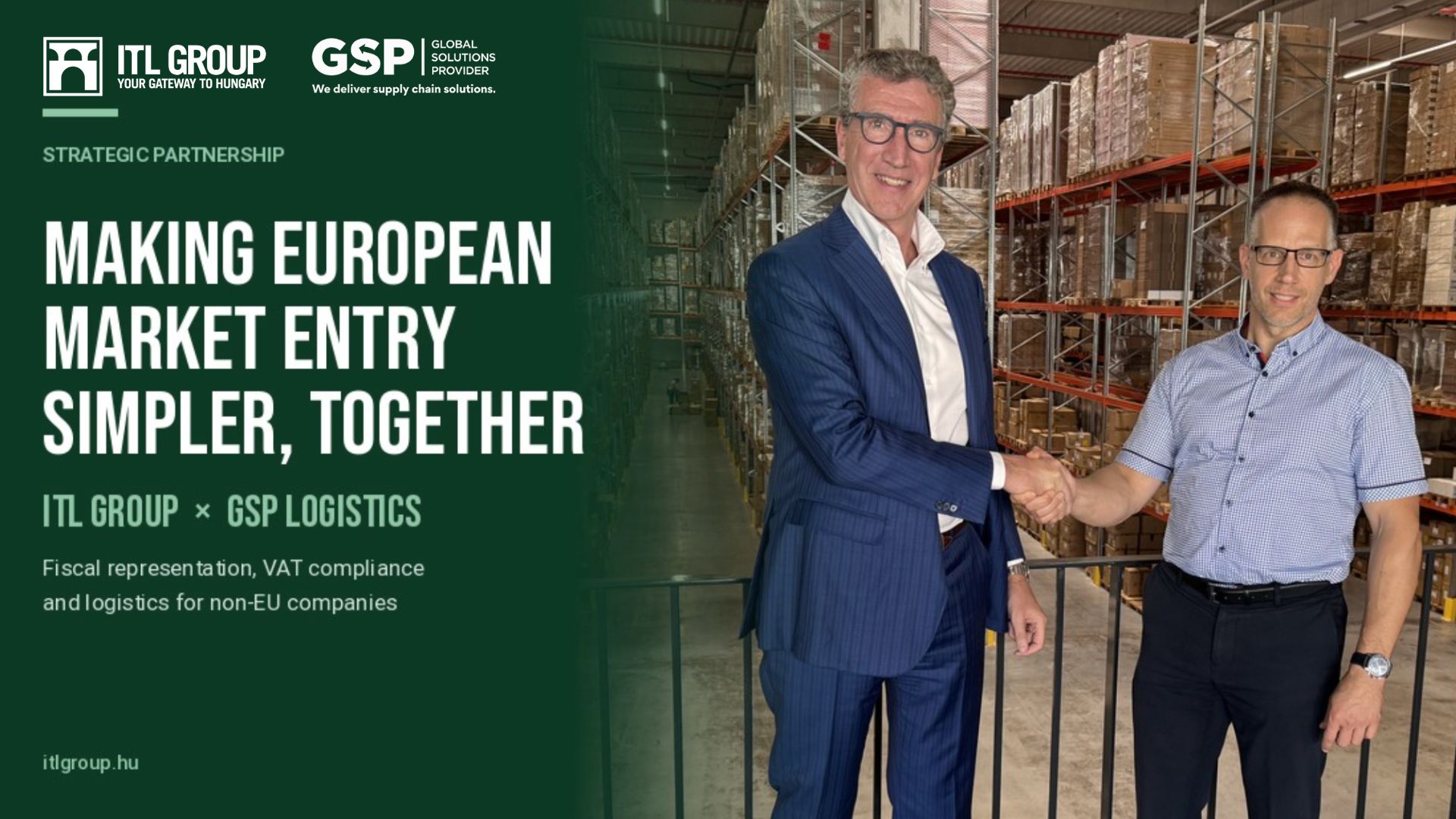
The Budapest partnership combines fiscal representation and full-service logistics under one point of contact, as EU customs reform forces exporters outside the Union to rethink how they reach European customers.
ITL Group, a Budapest professional services firm with nine specialist divisions, and GSP Logistics, a supply chain management company operating almost 17,000 square metres of warehousing at Vecsés, have formed a commercial partnership that packages their services into a single offer for companies entering the European Union.
Under the agreement, a company arriving from outside the EU deals with one team for what are normally five separate providers: company formation, VAT registration and fiscal representation on the one side; customs clearance, warehousing, order fulfilment and distribution on the other.
The timing follows a structural change in European customs rules. On 1 July 2026 the European Union removed the duty exemption on consignments valued below EUR 150 and introduced a flat customs duty of EUR 3 per item, a transitional measure that runs until 1 July 2028, when standard tariffs and the new EU Customs Data Hub take over. From 1 November 2026, Product Identifiers become mandatory on every declared item. In 2025, close to 5.9 billion low-value items were shipped directly from third countries to consumers in the European Union.
Fiscal representation meets the warehouse
The effect is to erode the economics of shipping parcels one by one from outside the Union, and to favour the alternative: importing goods in bulk, clearing customs once on entry, holding stock inside the single market and assembling the final shipment on European soil. Doing so, however, requires a company to exist both fiscally and physically inside the EU — the two capabilities the partnership brings together.
“Strong partnerships begin with a shared vision.
I am delighted to see ITL Group and GSP Logistics join forces to help non-EU companies approach the European market with greater confidence. Bringing complementary expertise together is the key to turning complexity into opportunity. This is only the beginning!” – Alessandro Farina
Hungary as the entry point
Both companies point to Hungary’s position as the practical argument. Four of the nine European Transport Corridors cross Hungarian territory, and the ring of logistics centres around Budapest is the product of two decades of infrastructure policy that extended motorways to the borders and built out border customs procedures. German-speaking markets and Northern Europe are one to two days away by road.
Cost remains a factor. Eurostat put Hungary’s average hourly labour cost at EUR 15.2 in 2025, against an EU average of EUR 34.9 and a euro area average of EUR 38.2 — a gap that feeds directly into the unit cost of labour-intensive operations such as picking, packing and quality control.
A different proposition from the platforms
Both firms describe the partnership as deliberately unlike the pan-European platforms that register clients for VAT across multiple member states. Their argument is that a mid-sized manufacturer or trading company entering Europe for the first time is poorly served by a model in which it is one account among many thousands, and better served by a named team in the country where its goods will actually sit.
“Our clients are not buying warehouse space.
We tell people honestly that Hungary is not the answer for everyone. If your goods arrive by sea and barely get touched, Rotterdam is hard to beat. If your operation is hands-on and your customers are spread from Munich to Bucharest, the arithmetic changes — and then what decides it is whether your customs partner can actually keep the VAT off your balance sheet.” – Andrási Bence, Country Manager, GSP Logistics
What comes next
This partnership is the start of a shared journey.
Planning your entry into the EU market? Contact ITL Group to find out how we can support you.
Recent posts