
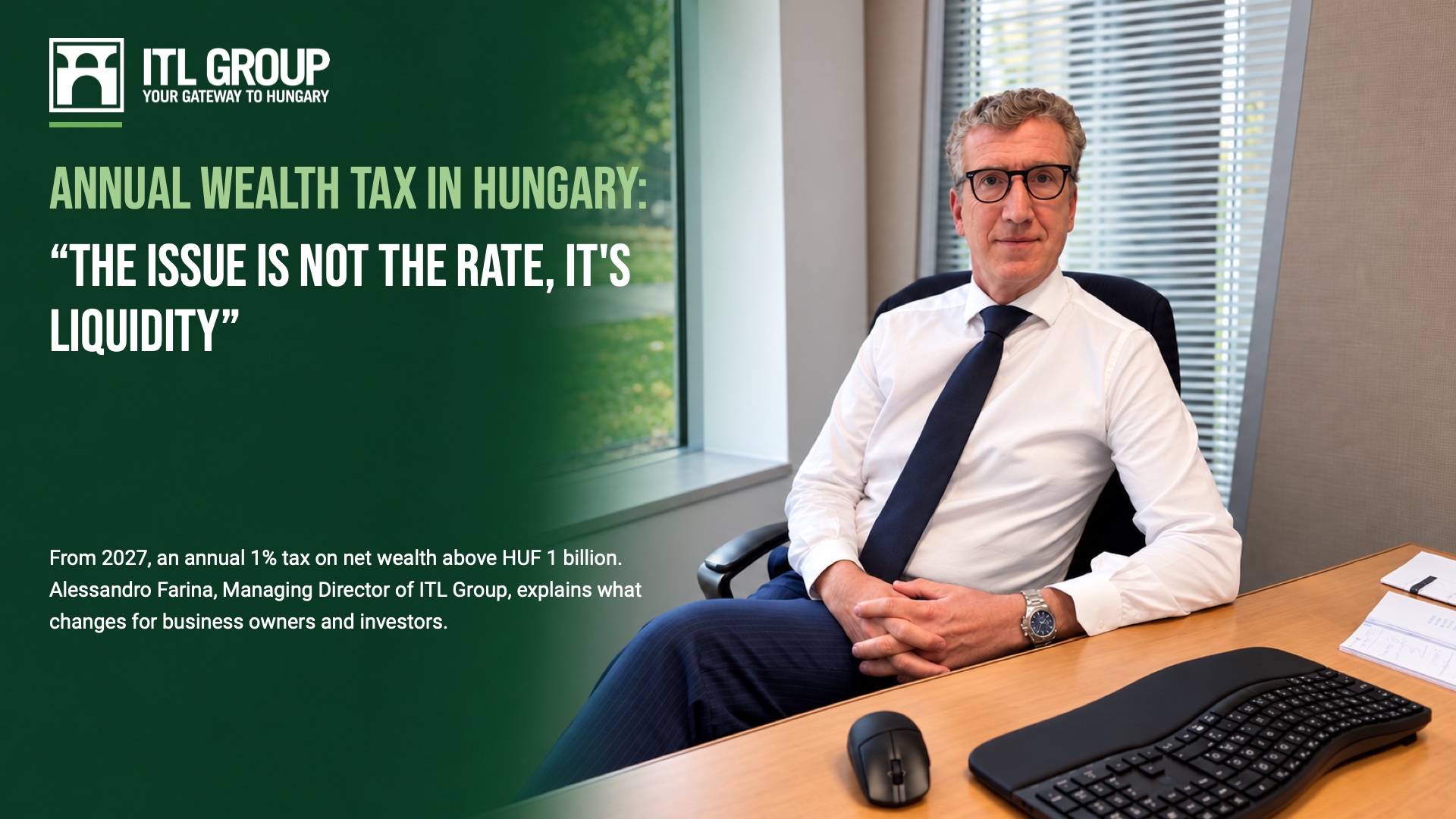
From 2027, an annual 1% tax on net wealth above HUF 1 billion. Alessandro Farina, Managing Director of ITL Group, explains what changes for business owners and investors.
On 6 October 2026 the Hungarian government presented its draft wealth tax bill (vagyonadó) and put it out for public consultation. If adopted in its current form, it will enter into force on 15 December 2026. Wealth will be assessed as at 31 December 2026, and the first return and payment will be due by 31 August 2027.
The measure affects a small group: according to the Ministry of Finance’s impact assessment, around 15,000 individuals and 2,000 wealth management structures. For those above the threshold, however, it changes the way wealth has to be managed. We discussed it with Alessandro Farina, Managing Director of ITL Group, who works every day with Italian and international entrepreneurs active in Hungary.
The proposal at a glance
- Who pays: individuals resident in Hungary, on their worldwide wealth. Non-residents, of any nationality, pay only on Hungarian real estate and on shares in Hungarian companies (or in foreign companies holding Hungarian real estate), if their net value exceeds the threshold. Trusts and private foundations are separate taxpayers. Spouses are taxed separately, each with their own threshold.
- Threshold: net wealth above HUF 1 billion (about EUR 2.7 million at the current exchange rate). The tax applies only to the portion above the threshold.
- Rates: 1% up to HUF 100 billion, 1.5% above.
- What is included: real estate (including the main home), company shares, cash, securities, crypto-assets and assets held abroad. Works of art, collections and jewellery worth more than HUF 3 million per item and vehicles worth more than HUF 10 million are also included.
- Unlisted companies: value is set by a formula: one third net equity and two thirds earnings value, based on average profits over the last three years.
- Deductions: documented debts reduce the tax base. Local taxes on real estate and vehicle tax are credited against the tax.
- An example: with net wealth of HUF 5 billion, the annual tax is HUF 40 million, about EUR 110,000.
Source: draft bill of 6 October 2026. The text is under consultation and may change.
A tax every year, not a one-off
What were your clients’ first reactions?
The first reactions, always the most emotional and immediate, were strong. Many of the business owners we work with were struck above all by one point: this is an annual tax. It is not a one-off levy like those some countries have used in the past in times of emergency.
Wealth taxes already exist in Europe. Why is this one so controversial?
It is true that they already exist in Europe, in partly similar and partly different forms. But they were introduced in more established economies, where wealth is more mature. In Hungary we are largely the first generation of people creating and building significant wealth.
That ability to build wealth was also made possible by a tax system that has so far been favourable: corporate income tax and personal income tax are low. Thanks to this combination, many business owners were able to save and build up assets. And that is certainly nothing to be ashamed of: the country chose this system, and those who invested here benefited from it.
The Hungarian tax system
- In Hungary corporate income tax is 9%, the lowest in the EU. Personal income tax is a flat 15%.
The context: prices, exchange rate and growth
What is the economic context for this measure?
The problem, as often in Hungary, is the tendency to change everything in a very short time, creating a shock. We have seen it in recent years: wages, consumer prices and property prices have grown at a pace the country had never experienced. Such rapid acceleration is never healthy, especially when the economy is growing slowly. Companies face rising costs and demand that is not picking up.
On top of that comes the exchange rate. For years the forint depreciated gradually and fairly predictably. Over the last year and a half, however, it has strengthened markedly against the euro. For the many companies that invoice in euros and pay their costs in forints, this is a heavy blow. I expect the 2026 accounts of many of them to show a significant drop in revenue and profits.
The figures
- Between 2015 and 2021 house prices in Hungary more than doubled (×2.1), the largest rise in the EU.
- In early 2023 inflation exceeded 25%, the highest rate in the Union.
- The euro averaged HUF 398 in 2025; in October 2026 it is worth about HUF 365. The forint has therefore strengthened by about 8%.
- After a weak 2025, GDP grew by 1.7% year on year in the first and second quarters of 2026.
The critical point: liquidity
Where do you see the main problem with the law?
The wealth tax is out of balance with the earning capacity of those who will have to pay it. Owning assets is one thing; having the cash every year to pay the tax is another. And not everyone has that liquidity on a continuous basis.
Wealth is made up of assets that generate income and assets that do not. Many portfolios were not built with this distinction in mind, because until now there was no need.
Can you give a concrete example?
The tax is paid by the individual, that is, the beneficial owner of the assets. That may be a business owner, but also an employee or someone who has received an inheritance. Take the business owner. First he pays tax on the company’s profits, then personal taxes on dividends. With what remains, after all those taxes, he must also pay the 1%.
Meanwhile he has to keep up his standard of living. Often he does not pay himself a high salary and lives mainly on dividends. The tax therefore takes an important resource away from exactly the savings that many intend to use in retirement, because they have not built up an adequate pension. These are mechanisms that do not work.
The technical point
- Shares in unlisted companies are valued on the basis of average profits over the last three years, even if those profits are not distributed. Tax may therefore be due on value that has not turned into personal cash.
- The draft allows taxpayers to ask the tax authority (NAV) for payment in instalments or a deferral: up to 12 months, or 24 in exceptional cases for homes and company shares. It is not automatic.
Rethinking the portfolio
What should people who fall within the tax actually do?
Review and reposition their investment portfolio in light of a liquidity need that did not exist before.
Here is a simple example. Someone who loves art and has invested in works of art will no longer look at a painting on the wall and think how beautiful it is or how much it cost. He will think about how much it costs him every year to keep it hanging there, because he will have to declare it and pay tax on it. The same goes for a car collection or for apartments that generate no income.
People will need to take pen and paper and review the choices they have made over the years. They will probably need to sell, convert or rebalance part of their investments. On the one hand to be able to pay the tax, on the other to grow their capital faster than inflation. Otherwise the capital stays the same on paper but loses value in real terms.
Beware of shortcuts
- The draft contains a general anti-avoidance clause. Transactions or valuations made solely to circumvent the rules can be challenged.
- Transferring assets to foreign structures managed from Hungary does not remove them from the tax either. Any restructuring must have genuine economic reasons and be documented.
The outlook
The law is still a draft. What do you expect?
We are following the process very closely, like many other professionals. We hope Parliament will take on board the changes that several experts have already called for and that so far do not seem to have been heard.
The point is not the rate: whether it is 1%, 2% or 0.5% matters less. What matters is that the tax is sustainable in the way it works and compatible with how a business owner manages liquidity. Otherwise we risk that companies already under pressure from the economic situation and the exchange rate will no longer be able to cope. Entrepreneurs are the engine of the economy: they need confidence and prospects for growth.
“The rate is not the point. What matters is that the tax is sustainable for a business owner’s liquidity.”
How ITL Group can help
What can ITL Group do for people in this situation?
We can help on several fronts, in an integrated way. We study the law and give tax advice on its impact, case by case. We handle property valuations through our real estate division and company valuations through our consulting division. Together with dedicated partners, we can also offer advice and support in designing the portfolio.
We do not sell or buy financial products: that is not our business. Our role is to work through with the business owner how to reorganise their assets to better balance the future.
ITL Group support
- ITL Tax Advisor: review of the personal position, estimate of the tax due, advice on the rules and deadlines.
- ITL Real Estate: independent property valuations, useful when the NAV value does not reflect the market.
- ITL Consulting: valuation of company shares using the statutory formula or, where allowed, an independent valuation.
- Dedicated partners: analysis of the composition of wealth and of liquidity needs over the years.
Is your wealth approaching the HUF 1 billion threshold?
Contact us for an initial confidential review of your position. Write to a.farina@itlgroup.hu or call (+36 1) 269 5679.
This information is based on the draft bill published on 6 October 2026 for public consultation and may change during the parliamentary process. It does not constitute tax advice.
Recent posts